

Guides
French home or condo: which spaces are really yours?
Match gardens, terraces, courtyards and access to the actual ownership documents instead of importing assumptions from a familiar US condominium.
Contents
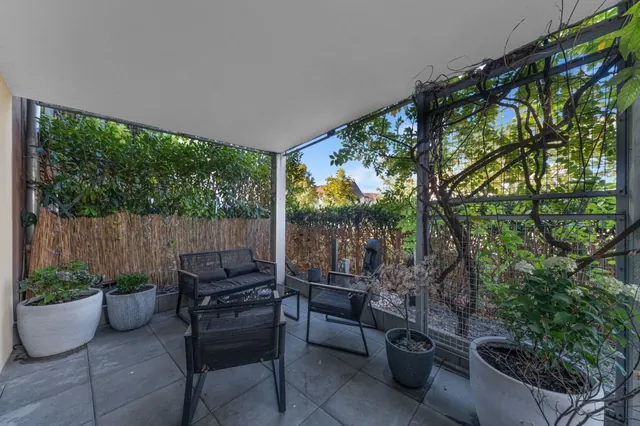
A house has a small enclosed garden; an apartment opens onto a generous terrace. In photographs, comparing the outdoor space seems straightforward. Yet access, exclusive use, and ownership are not necessarily the same thing. If your reference point is an American condominium or a home held under a different arrangement, set aside the automatic equivalents. For the French property, the documents applicable to each space should explain the relevant rights and limits. The marketing description and the physical appearance are starting points for questions, not substitutes for those documents.
Read the property one space at a time
Take a plan and follow an ordinary route: street, gate, passage, entrance, living room, terrace, garden, and parking. At each point, ask which document describes the space and how it relates to the property for sale. Do not rely only on a fence or possession of a key. A photograph shows a physical arrangement; it does not by itself establish who owns the land, who may use it, or which conditions apply.
This method is useful for a house as well as an apartment. “House” describes a building in everyday language; it does not replace examination of the property's legal organization. Similarly, experience with a particular American condominium does not automatically explain a French copropriété. Return to the documents for the actual property instead of attempting a universal comparison between two countries or assuming that familiar terminology carries identical consequences.
Distinguish ownership from exclusive use
Service Public explains that a common area can be reserved for one co-owner’s exclusive use without becoming that person’s private property. A garden or terrace therefore deserves a precise documentary question. Which right is described, which lot is it attached to, and where is it recorded? Have the response and any necessary additional documents examined. A brief phrase in a listing should not become your only reference for an important purchase assumption.
Annotate your plan carefully: status established by a named document, use described but supporting information incomplete, or status still to clarify. Avoid using “private” as if the word answers every question. In conversation it may mean that nobody else normally uses the space, while you are asking about a particular legal right. A fuller annotation forces the meaning to be explained and prevents a casual description from silently turning into a conclusion about ownership.
Test the uses that actually motivate the purchase
List a few things you want to do: eat outdoors, store bicycles, install equipment, alter a fence, or reach an outbuilding. Ask which document or check relates to each intended use. The physical possibility of placing an object does not establish permission to do so. Conversely, an unanswered question is not proof that an activity is forbidden. It is a reason to obtain the appropriate explanation before treating the proposed use as settled.
Describe the project precisely enough to avoid abstract answers. “Can we enjoy the garden?” differs from “Which checks are necessary for this specified alteration?” The syndic, notaire, and relevant authority or professional can identify the applicable questions. Do not order equipment or start a project based solely on your interpretation of a marketing plan. A modestly described use can be examined more effectively than an open-ended request to approve anything you might later wish to do.
Include maintenance and access in the same exercise
Once the status is understood, ask who maintains the element, who organizes interventions, and how costs are documented. Use the applicable records rather than inferring every responsibility from exclusive use alone. A roof, terrace, or passage may involve several components treated differently. Ask for the boundaries to be explained instead of searching for one answer supposedly covering everything visible in the same photograph.
Also trace access to equipment and ancillary spaces. If maintenance requires crossing another part of the property or a shared area, ask how that works and what supports the arrangement. The purpose is not to invent every imaginable dispute. It is to understand the ordinary uses your project relies on. Access demonstrated during a viewing should be connected to relevant documentary information, particularly where it is important to your intended use of the home.
Compare two properties with the same questions
Repeat the route for the second property. A smaller courtyard with clearly understood rights and uses may fit your plans better than a larger outdoor area that remains poorly explained. This is not a universal ranking of private ownership against exclusive enjoyment. It is a comparison against your actual needs, with the responsibilities and limitations that have been established rather than guessed from the photographs.
The French copropriété guide adds the wider building documents to this space-by-space reading. For a house or apartment near Dijon and Beaune, ask Shawez Ali, real estate agent, about the available records and the spaces presented. Then have the relevant professionals confirm the rights and conditions before deciding that the terrace or garden really corresponds to what you intend to purchase.